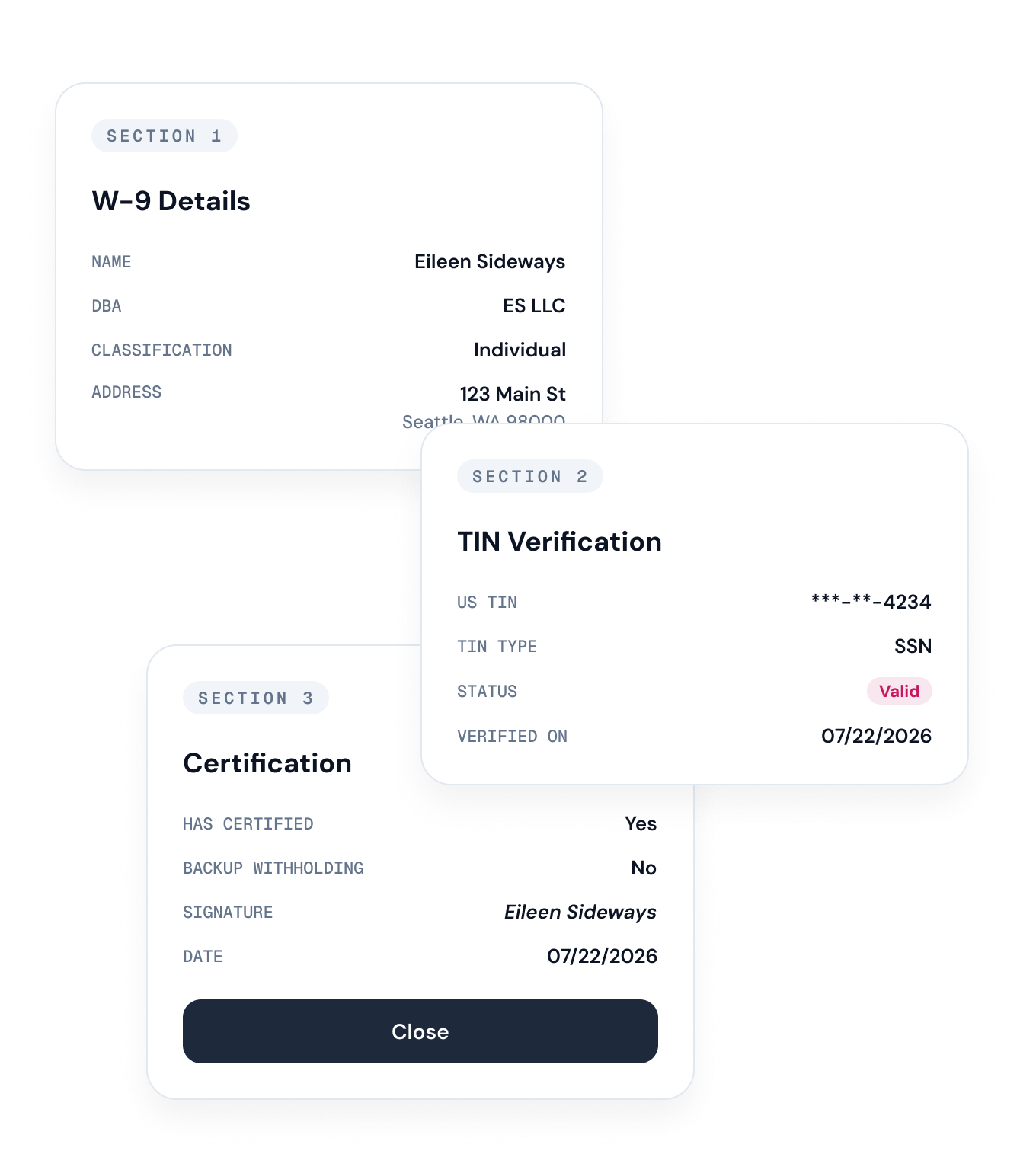


Most reporting problems start at onboarding. Taxbit collects and checks tax forms inside your own product, before the first reportable transaction.
Collected inside your product
W-9 and W-8 forms collection embedded in your own onboarding flow
Matched with the IRS
US TINs checked against IRS records in real time, so a bad number is caught at signup, not in a B-Notice months later.
Watched after signup
Expirations and changes in a customer's circumstances are tracked, so the form on file stays valid.
Withholding settled up front
Each customer's tax status decides whether a withholding rate applies, before any payment goes out.
Information Reporting
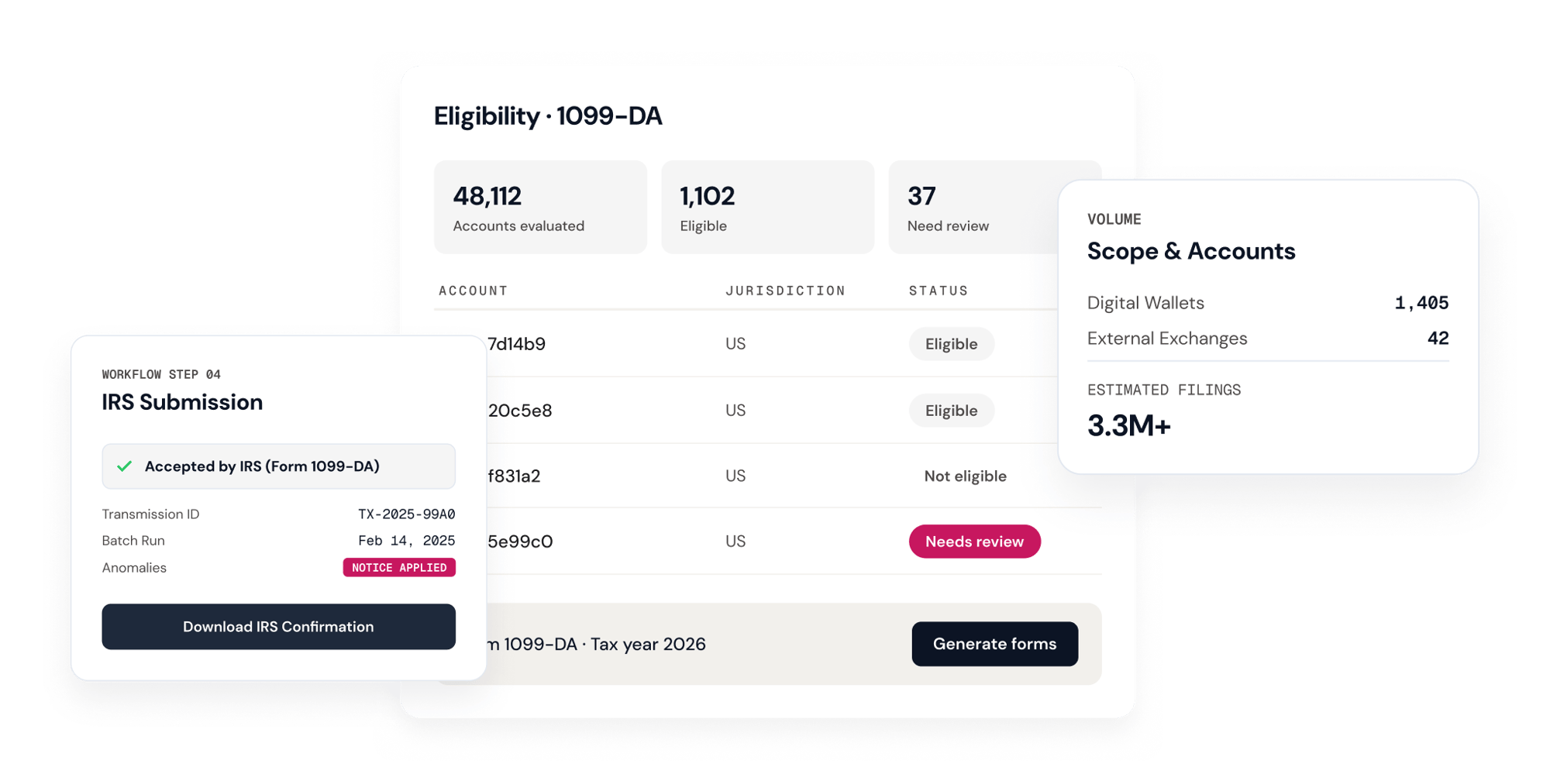
Taxbit works out who is reportable and on which form, then generates, files, and corrects the returns from the same record. It filed the first 1099-DA season with zero misses.
Eligibility
US or non-US, which transactions are reportable, and whether calendar-year thresholds are met, decided for each account from your own data.
Generated and filed
Returns filed with the IRS and states, and recipient copies delivered, across the 1099 series and 1042-S.
Cost basis for 1099-DA
Lot-level cost basis resolved across wallet and platform transfers, from your raw transaction data.
Corrections and B-Notices
Corrected returns filed, and IRS B-Notice files turned into a list of name and TIN mismatches to fix.
When the rules change
Each of these changes meant rebuilding something. Taxbit customers didn't have to.
A new IRS filing system
The IRS is replacing its FIRE filing system with IRIS, which changes how every return is sent. Taxbit moved its customers' filing over.
1099-K thresholds
The 1099-K reporting threshold has changed several times in recent years. Taxbit tracked each change and applied it to who gets a form.
Cost basis on 1099-DA
1099-DA started with proceeds only. Cost basis is now required for crypto bought from 2026 onward, and Taxbit added it to the same filing.
The series
Form
What it reports
W-9
Tax status and TIN for US persons, collected at signup
W-8 series
Foreign status for non-US individuals and entities, collected at signup
1099-DA
Proceeds, and phased-in cost basis, from digital-asset sales and exchanges
1099-K
Payment-card and third-party network transactions
1099-NEC
Non-employee compensation
1099-MISC
Rents, royalties, and other income
1099-INT
Interest paid on customer balances
1099-DIV
Dividends and distributions
1099-R, 5498, RMD
Retirement account distributions, contributions, and minimum distributions
1042-S
US-source income paid to non-US persons, with withholding
1042
The payer's annual withholding return
Gain/loss statements
Realized gain and loss, from the same cost-basis engine
1098
Mortgage interest, points, and premiums, for mortgage lenders and servicers
1098-VLI
Interest on qualifying passenger vehicle loans, for auto lenders
1099-A
Acquisition or abandonment of secured property, such as foreclosures and repossessions, for secured-property lenders
1099-B
Proceeds from securities sales, for brokerages
1099-C
Cancellation of debt, for card issuers, BNPL providers, and lenders
W-2G
Gambling winnings , for online gaming, sportsbook, and casino operators
How Taxbit handles it
The old way
With Taxbit
“Together, we have enabled a seamless tax onboarding experience for Uphold's US customers. And as a Taxbit customer myself, I can safely say their team has provided us with world-class support.”
Marco Martins · Lead Product Manager, Uphold

It's the returns businesses file with the IRS, and the copies they send customers, to report payments and transactions: the 1099 series, plus 1042-S for payments to non-US persons. It starts with the W-9 and W-8 forms you collect to know each customer's tax status. Taxbit handles all of it, from collecting forms at signup to filing returns at year-end.
Form 1099-DA is the IRS form US crypto brokers use to report their customers' crypto sales and exchanges. It works like Form 1099-B does for stocks, giving the IRS and the customer a record of what was sold.
US crypto brokers that hold crypto for their customers, including exchanges, some wallet and custody providers, and payment processors that sell crypto for customers. They file a form with the IRS for each reportable customer and send the customer a copy.
It covers sales from January 1, 2025, so the first forms were filed in early 2026. Brokers reported sale proceeds first, and cost basis is required for crypto bought from January 1, 2026 onward.
Yes, for crypto bought from 2026 onward. Cost basis is the hard part, because it has to follow crypto as it moves between wallets and platforms, and the record of what the customer paid is often on a different platform from the sale.
1099-B covers stock and securities sales. 1099-K covers card and payment app transactions. 1099-DA is just for crypto sales. A business that sells crypto and also pays out through cards or payment apps may file more than one, and Taxbit creates all of them from the same data.
No. Form 1099-DA is the IRS form for US crypto brokers. DAC8 is the EU's crypto reporting rule, filed with EU tax authorities. A platform with both US and EU customers may need to file both, and Taxbit creates both from the same data.
It depends on what you do. Crypto sales need 1099-DA, card and payment app payouts need 1099-K, payments to contractors need 1099-NEC, interest or rewards on customer balances need 1099-INT or 1099-MISC, and payments to non-US persons need 1042-S. Most businesses file several, and Taxbit creates them all from the same data.
A W-9 is how a US person gives you their taxpayer identification number (TIN) and certifies their status. A W-8 is how a non-US person or entity certifies foreign status, which decides whether withholding applies and whether they get a 1099 or a 1042-S. Taxbit collects both in the same onboarding flow.
TIN matching checks that the name and taxpayer identification number a customer gives you match IRS records. Taxbit does it in real time at signup, so mismatches get fixed before year-end instead of turning into B-Notices.
Form 1042-S reports US-source income paid to non-US persons, and any tax withheld. The payer also files Form 1042, an annual withholding return. Taxbit generates both from the same records it uses for your 1099s.
A B-Notice is the IRS telling a payer that the name and TIN on a 1099 don't match its records. Taxbit reads the IRS files, lists the mismatches, and produces what you need to fix them.
IRIS is the IRS's new system for filing information returns electronically, replacing the older FIRE system. Moving to it changes how returns are sent to the IRS. Taxbit handles that move for its customers.
1099-DA filed against your own transactions, with cost basis resolved across transfers, and the rest of the forms your accounts owe generated from the same data.